
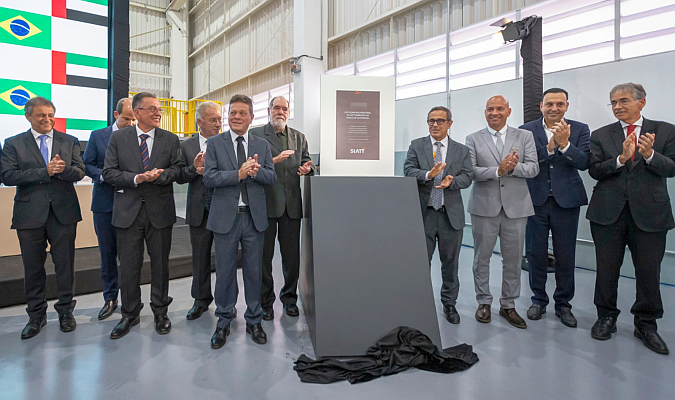
SIATT has begun operations at its new industrial facility in Caçapava, in the interior of the state of São Paulo. The start of operations of Phase 1, marked by a ceremony held on Wednesday (August 26), expands the company’s capacity to develop, manufacture, integrate, test and qualify highly complex systems for the Defense and Space sectors.
The ceremony brought together civilian and military authorities, members of the team and invited guests. The official ceremony was attended by the Minister of Science, Technology and Innovation, Luis Fernandes; the Vice Governor of the State of São Paulo, Felicio Ramuth; the Chairman of SIATT’s Board of Directors, Azhaury Cunha Filho; the President of EDGE Group’s Missiles and Weapons Cluster, Saif Al Dahbashi; the Mayor of Caçapava, Yan Lopes de Almeida; Fleet Admiral Carlos Chagas Viana Braga, Commandant-General of the Brazilian Marine Corps; Army General Hertz Pires do Nascimento, Head of the Department of Science and Technology; and SIATT’s Chief Executive Officer, Rogerio Salvador.
“A country that intends to decide its own future must also be able to make its own choices, and that freedom is sustained not only by military capabilities, but also by science, engineering and an industry capable of turning knowledge into concrete solutions,” said the Chief Executive Officer.
The new facility brings together infrastructure and resources for the production of smart weapons, such as missiles and guided rockets, as well as rocket motors and other propulsion systems for space applications. Phase 1 of the facility comprises 6,200 square meters of built area. Designed to support Brazilian strategic programs, the project strengthens the country’s technological autonomy and has been structured to allow for future expansion in line with the evolving needs of Brazil and the international market.
With the start of operations at the facility, SIATT now brings together in Caçapava industrial and technological capabilities related to the manufacture of strategic systems and the mastery of critical technologies for the Defense and Space sectors.
“There is a fundamental difference between mastering a technology and having the industrial capacity to produce it reliably, repeatedly and at scale. Our headquarters in São José dos Campos, inaugurated last year, and this facility in Caçapava, which begins operations today, represent precisely that transition. We are transforming knowledge accumulated over many years into permanent industrial capacity,” said Azhaury Cunha Filho, Chairman of SIATT’s Board of Directors.
Industrial and Technological Capacity
The SIATT Caçapava Facility was designed to encompass all stages of the development and production of missiles, guided rockets, rocket motors and propulsion systems.
Its infrastructure supports the industrialization of strategic technologies for programs of national interest. The completion of the first phase is part of the investment cycle aimed at establishing and consolidating this set of capabilities.
The project also provides for phased expansions in line with the evolution of programs and market demand. In this way, the facility creates conditions for establishing new partnerships, developing products and expanding SIATT’s international presence.
Strengthening Brazil’s Defense Industrial Base
The start of operations at the Caçapava Facility expands Brazil’s capacity to develop, qualify and manufacture missiles and other advanced Defense systems, contributing to the consolidation of the Brazilian Defense Industrial Base (BID).
The initiative supports Brazil’s pursuit of greater sovereignty and technological autonomy in strategic areas. By strengthening its manufacturing infrastructure and expanding its mastery of critical technologies, the facility helps reduce external dependencies and increases the country’s capacity to manufacture systems essential to national defense.
In addition, the new infrastructure paves the way for SIATT’s participation in strategic programs and partnerships with companies, science and technology institutions, and national and international organizations. This movement supports the development of new technologies and expands opportunities for the company to enter the global market.
Defense and Space
The facility also enables SIATT to expand its operations in the space sector, particularly in the development and manufacture of rocket motors and propulsion systems.
This capability strengthens national expertise and contributes to the advancement of the Brazilian Space Program. By bringing together knowledge and technologies applicable to both the Defense and Space sectors, the company expands its capacity to develop new products for different high-technology markets.
The convergence of these areas supports the shared use of facilities, knowledge and engineering capabilities. As a result, the Caçapava Facility reinforces Brazil’s position in technologies of high strategic value.
Next Steps
The implementation of the SIATT Caçapava Facility will take place in different phases. Phases 2 and 3 provide for further infrastructure expansion and successive increases in the production capacity of systems for the Defense and Space sectors.
As these phases progress, SIATT will be able to support a greater number of the country’s strategic programs and pursue new opportunities in the international market, in alignment with State policies and Brazilian guidelines for the export of Defense products and technologies.
The facility will also increase demand for specialized professionals, creating skilled jobs and contributing to regional development. The Caçapava Facility is expected to generate 640 jobs, including 160 direct and 480 indirect positions, by the completion of the project. The expansion will also strengthen the ecosystem formed by companies, universities, research centers and institutions specializing in engineering, technology and high-complexity industry. The start of Phase 1 operations marks a new stage in SIATT’s trajectory, supported by investments in infrastructure, workforce development, innovation and strategic partnerships in the Defense and Space sectors.
Source: SIATT