
Amazon Conservation and SOS Amazônia have released a new special report examining how proposed road expansion in the Brazilian state of Acre could affect its forests and more than a decade of progress under the world’s first jurisdictional REDD+ program.
The report, Acre at the Crossroads: How Road Expansion Threatens a Decade of REDD+ Progress in the Brazilian Amazon, models three infrastructure scenarios for Acre’s road network and assesses their impact on deforestation and carbon credit revenue that Indigenous and forest communities benefit from. The analysis finds that a proposed paved international connection between Acre and Pucallpa, Peru, could drive approximately 74,700 hectares (nearly 185,000 acres) of additional deforestation over ten years and 133,800 hectares (over 330,000 acres) over twenty years, beyond the impacts already expected from paving the existing BR-364 highway.
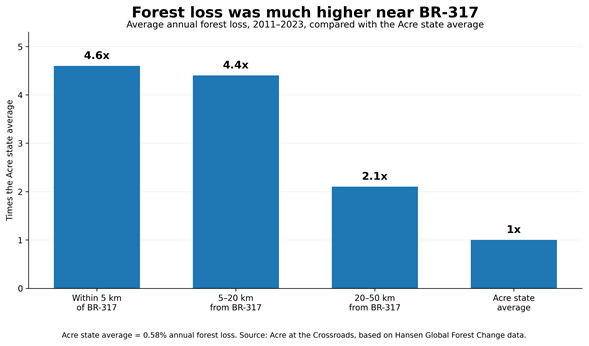
The projections draw on Acre’s own history: after BR-317 (the existing road connecting Brazil to Peru) opened in 2010, forests within 5 km of the road were lost at 4.6 times the statewide average. At the same time, the road carried only a small share of the state’s trade, falling short of the economic transformation it had promised.
Researchers also warn that rising deforestation along new road corridors could jeopardize up to US$1.83 billion in potential carbon credit revenue projected for 2023–2027, 72% of which is allocated to forest communities under Acre’s Benefit Sharing Plan. While the report recognizes the rehabilitation of the BR-364 as a legitimate need for communities that lack reliable, all-season access, it recommends that it must come with strong enforcement and protected-area management. Also concludes that the Pucallpa route is not worth the risk versus its benefits. The proposed road would cross Serra do Divisor National Park, home to Indigenous peoples living in voluntary isolation; local communities report they have not been consulted, and economic studies show the road would cost over US$400 million more than it would generate.
The report calls for stronger governance along the BR-364 corridor, including rigorous environmental assessment, licensing, monitoring and enforcement, and recommends that Acre make better use of its existing connection to Peru while investing future carbon credit revenue in a forest-based bioeconomy, connecting products such as Brazil nuts, rubber and certified timber to global markets.
Read the full report available in English and Portuguese.
Source: Amazon Conservation