
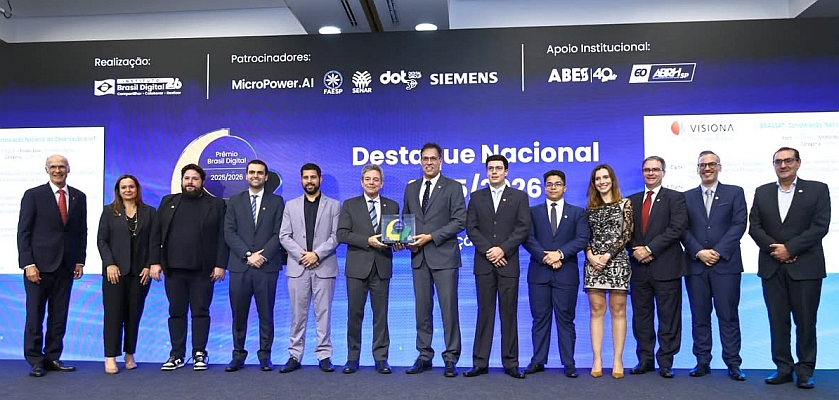
Visiona Tecnologia Espacial was honored with the “National Highlight” (Destaque Nacional) award at the 2025/2026 Ozires Silva Brazil Digital Awards for its “Brassat” project—a national constellation for Earth observation and IoT (Internet of Things) communication. The ceremony, held last Monday (November 9) at the Renaissance São Paulo Hotel, recognized initiatives that foster innovation, digital transformation, and positive impact on Brazilian society. The “National Highlight” title represents the highest level of recognition offered by the awards.
Developed by Visiona in partnership with the SENAI Institute for Innovation in Embedded Systems, the Brassat project proposes the creation of a Brazilian space infrastructure based on a constellation of small satellites designed for Earth observation and the transmission of IoT data.
Inspired by the European Space Agency’s (ESA) successful Copernicus program, the Brassat project—which is currently seeking funding for further development—aims to promote the use of geospatial technologies in Brazil. It intends to do so by providing free access to high-quality, high-resolution satellite imagery, thereby supporting the digital transformation of various sectors and strengthening Brazil’s technological sovereignty.
The proposal incorporates technologies developed through the VCUB1, SatVHR, and Catarina programs to enable the mapping of the entire national territory, with high-resolution imagery updated every five days. Making this data available could accelerate the adoption of geospatial solutions in fields such as agriculture, infrastructure, environmental protection, natural resource monitoring, and land management.
The socioeconomic potential associated with these applications is significant. According to the World Economic Forum, the full utilization of remote sensing and Earth observation technologies could lead to a $700 billion increase in global GDP by 2030, along with a reduction in greenhouse gas emissions of 2 gigatons of CO2 equivalent per year—with Brazil poised to play a leading role, given the unique characteristics of its territory and economy.
“Brassat will enable the digitalization of processes across various economic sectors, bringing space technology into people’s daily lives. Brazil stands to benefit more than any other nation from the application of geospatial technologies—whether for economic development, the innovation of public policy, or environmental protection,”
says João Paulo Rodrigues Campos, CEO of Visiona.
Beyond expanding access to strategic data, the project also has the potential to strengthen the national space industry by creating recurring demand for technologies, products, and services developed within Brazil.
“For a long time, the Brazilian space sector has struggled with investment volatility. Brassat breaks this cycle by fostering recurring demand for the domestic industry, anchored in the value generated by the constellation itself. The project represents a convergence of technological excellence, strategic vision, and tangible impact. It translates the expertise developed by SENAI and Visiona in advancing space technologies in Brazil into concrete benefits for both the industry and society,”
states Paulo Alberto Violada, Head of the SENAI Institute for Innovation in Embedded Systems.
For those behind the initiative, this recognition reinforces the space sector’s potential as a catalyst for innovation, competitiveness, and economic development. “Projects like Brassat reinforce Senai’s role in connecting scientific knowledge, technological development, and the concrete needs of the productive sector. By working on the development of space technologies, we contribute to creating capabilities and solutions that can be adopted by various segments of the economy, while simultaneously strengthening the technological capacity of the Brazilian industry,”
highlights Fabrízio Pereira, regional director of Senai/SC.
Brassat has been approved and incorporated into the Brazilian Space Agency’s (AEB) project qualification portfolio, which attests to the proposal’s conceptual relevance and technical rigor. The project continues to progress through the stages of the AEB’s Procedure for the Selection and Adoption of Space Missions (Prosame), with the goal of potential future contracting.
With information from Visiona
Cover image: copyright © Claudio Vieira/PMSJC