

In September, the National Institute for Space Research (INPE) carried out two significant operations in preparation for the launch of the Amazonia-1B satellite, the second satellite in the Amazonia series.
These activities included a simulation of the satellite’s transport logistics and a technical visit to the Guiana Space Centre, where the satellite is scheduled to be launched in September 2027.
Simulation of satellite transport logistics
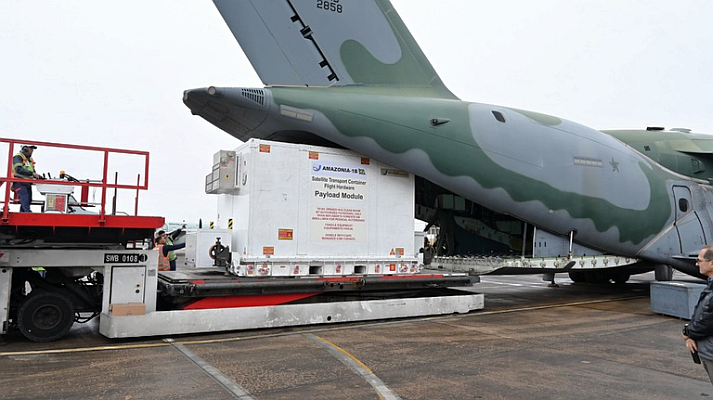
On September 14, teams from INPE (National Institute for Space Research), the Brazilian Air Force (FAB), and SJK Airport conducted a simulation to verify the procedures required for transporting the Amazonia-1B satellite to French Guiana. The activity took place at SJK Airport in São José dos Campos (São Paulo state) and was primarily aimed at assessing the feasibility of transporting the Amazonia-1B satellite using a Brazilian Air Force KC-390 aircraft.
The operation replicated the key stages involved in the actual transport process, ranging from the departure of the container from INPE’s Integration and Testing Laboratory (LIT) to its loading onto the aircraft. The test also allowed for an evaluation of how the container fits inside the KC-390, helping to identify any necessary adjustments ahead of the planned 2027 mission.
The container used in the simulation—which weighs 6,790 kilograms when empty—was transported by road from INPE to the airport and subsequently moved into the aircraft. The operation was completed successfully.
The activity involved engineers and specialists from INPE, representing the project’s electrical, mechanical, product assurance, and logistics teams. The Brazilian Air Force was represented by Captains (Aviators) Possidônio F. da Silva Junior and Lucas Araújo L. Assis, accompanied by personnel from the “Zeus” Squadron, based at the Anápolis Air Force Base (Goiás state). The operation was also supported by staff from SJK Airport. For Adenilson Silva, General Coordinator of Space Engineering, Technology, and Science (CGCE) at INPE, this activity is part of the launch preparations, further increasing Brazil’s involvement in the mission:
“For the launch of the Amazonia-1B satellite, we are expanding Brazil’s participation. The transport will be carried out by a cargo aircraft manufactured in Brazil and operated by the Brazilian Air Force (FAB). We are very pleased with this partnership, which makes the mission even more ‘Brazilian.’”
David Oliveira, who works on the planning of the logistics operation, commented on the process:
“The simulation was of great importance in demonstrating, in practice, the compatibility of the KC-390 for transporting the container—and, most importantly, in allowing us to anticipate and avoid any unforeseen issues on the day of the official shipment to French Guiana. Throughout the activity, our team closely monitored every stage of the handling process, and everyone was eager to see the outcome. It was an operation that required a high level of attention and coordination, and the success of the simulation demonstrated the capability and professionalism of the FAB team in carrying out this operation.”
Technical visit to the Guiana Space Centre
Between September 15 and 18, individuals responsible for various areas of the Amazonia-1B project at INPE—Adenilson Silva, Bruno Braz, Arcélio Costa Louro, Valentino Lau, Guilherme Venticinque, and Hadler da Silva—along with AEB coordinator Felipe Fraga, visited the Guiana Space Centre in Kourou for a technical visit focused on logistics planning and launch preparation.
The mission aimed to assess the infrastructure and equipment, as well as to familiarize the team with the Centre’s operational procedures and standards—information essential for planning the launch campaign.
The Guiana Space Centre is located near Kourou, approximately 60 kilometers from Cayenne, the capital of French Guiana. It serves as the primary spaceport for the European Space Agency (ESA) and is used for the launch of vehicles such as the Ariane 6 and Vega-C.
According to Adenilson Silva, the mission allowed the team to preview and verify the conditions they will encounter during the launch campaign.
“The Kourou Space Centre boasts excellent infrastructure and strict safety standards. It is, without a doubt, among the best facilities of its kind in the world,” he explained.
Previous initiatives by INPE involving similar missions also contributed to this effort.
“INPE’s prior experience with launches at various spaceports facilitated the exchange of information and helped confirm that the requirements of the Amazonia-1B mission are compatible with the capabilities and procedures in place at the Centre,” stated Bruno Braz, one of the Amazonia-1B project managers.
Next steps for Amazonia-1B

Following the operations carried out in September, work on the Amazonia-1B satellite has entered a new phase of preparation for environmental and qualification testing.
The satellite is expected to undergo environmental testing in the first quarter of 2027. Its transport to French Guiana is scheduled for August 2027, with the launch planned for September of the same year.
Amazonia-1B will continue the Amazonia series of satellites, developed by INPE for Earth observation applications. The first satellite in the series, Amazonia-1, was launched in 2021 from the Satish Dhawan Space Centre (SHAR) in India. Its development, integration, and testing were carried out entirely by the Institute; by 2026, the satellite had reached five years in orbit, operating with excellent performance.
Source: INPE